ADDIE is an instructional framework that focuses on iterative reflection, and marginal improvement over time. Created in the 1970’s at Florida State University for the U.S. Military, many educators have found it very useful in Lesson and Unit Creation and improvement. (Drljača, 2024)
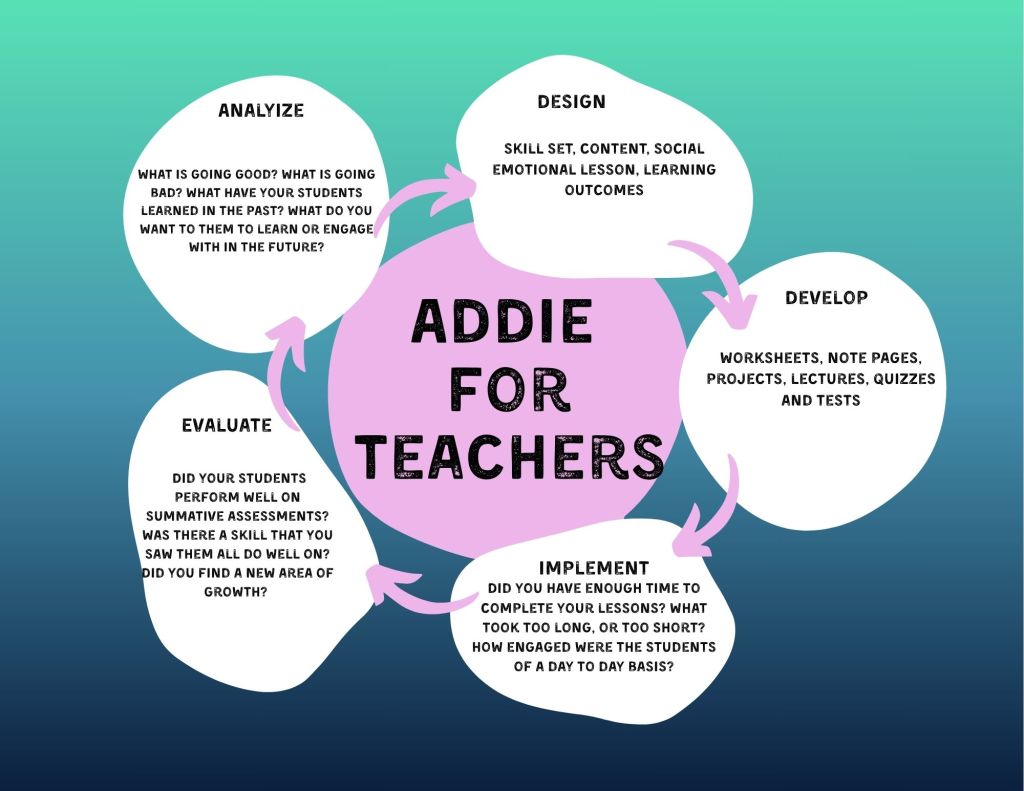
ADDIE Stands for Analysis, Design, Develop, Implement, and Evaluate. (expanded upon bellow)
Analysis
A: Observe and analyze what is happening in your classroom. Ask, what is going well? What is going poorly? What have your students learned in the past? What do you want them to learn or engage with in the future? When you have answers to these questions, you move on to design.
Design
D: Design a lesson or unit around what you want your students to learn. This can be a skill set, content, social emotional lesson, or anything you want them to do. It can be long or short term. This plan can be for a project and the material surrounding it. It can be for a novel study; it can even be for a whole unit or class depending on what you will be working on with your students. When you have a design, which is no small task, it is time to develop how you will represent it to your students.
Develop
D: Develop the worksheets, note pages, projects, lectures, quizzes, and tests. In teacher speak, these are the formative and summative assessments. These worksheets are up to you; there is no one size fits all. This section has the most diverse amount of ideas from teachers because we all have opinions on what is the best way to teach. What should be similar for all teachers is that their teaching materials and content should be aligned with desired student outcomes, your learning environment (online, blended, or in class), and your understanding of what engages your students. Not sure what will work best? THAT IS OKAY! That is exactly why we are using this framework. And now we implement.
Implement
I: The Implementation part of this framework is where you record how your lessons worked mechanically. Did you have enough time to complete your lessons? What took too long, or too short? How engaged were the students on a day-to-day basis? This information, coupled with the Evaluate portion, is where the real growth happens.
Evaluate
E: in this section you Evaluate the assessments of the lesson, and see how well the students grasped the concepts you chose in the design section. Did your students perform well on summative assessments? Was there a skill that you saw them all do really well on? Did you find a new area of growth? Based on this evaluation, you are ready to Analyze, Design, Develop, Implement, and Evaluate all over again, getting better each time! (e-Learning Infographics, 2017)
As you can see, there is a strong use case for educators, but I wanted to point out the potential uses of ADDIE for students.
At its core, ADDIE is a framework for problem-solving. The problem that teachers use it for is lesson creation and development, but students will find the design process to be very useful in solving their academic problems.
An example of a student use case that I run into as an independent study teacher is students not being able to organize their schedule to get all of their coursework done on time. You could have your students Analyze the problem and what has been failing in their method of completing work; Design the outcomes that they want and make goals for themselves; Develop a plan based on the goals and outcomes they are looking for; Implement the plan, and record how it goes, and then; Evaluate the effectiveness and reexamine the problem and change up the plan to try and do better.
This use case is an example of the saying “Good Teaching is Good Learning”. What is good for your own learning, is going to be good for your teaching. Education teachers should be using the best practices to model to their students the best way to do it. Teachers should model the best way to do things for thier students and show them how to be the best students they can be.
References
Drljača, D. P., Tomić, S., & Ris, K. (2024). Benchmarking Instructional Design Models – Addie Wins. Economy & Market Communication Review / Casopis Za Ekonomiju i Trzisne Komunikacije, 14(2), 688–698. https://doi.org/10.7251/EMC2402688D
e‑Learning Infographics. (2017, August 8). The ADDIE Model Infographic [Infographic]. Retrieved June 22, 2025, from https://elearninginfographics.com/the-addie-model-infographic/

 Try Again Teaching
Leave a comment